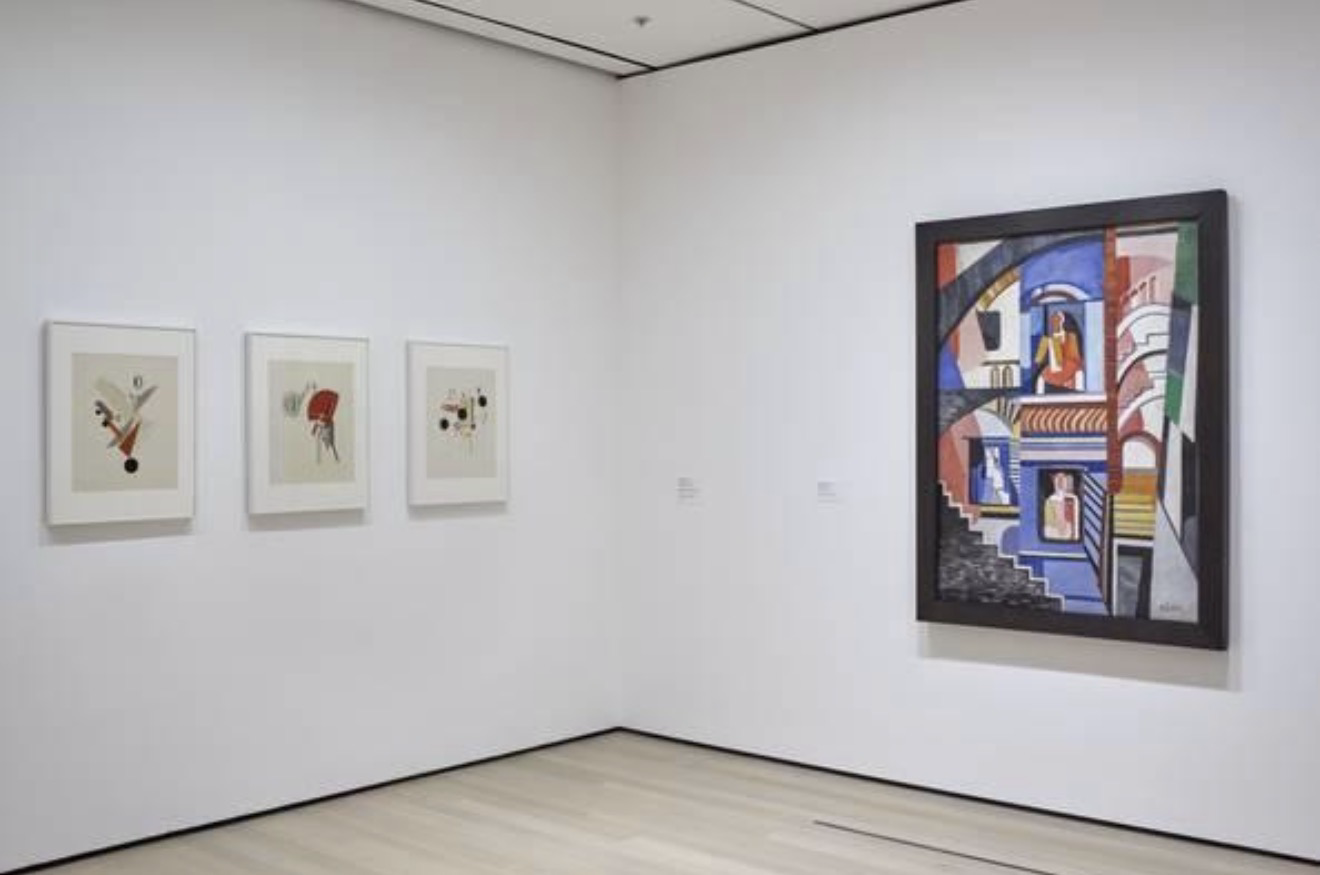
Alexandra Exter (1882–1949) was one of the most significant artists of the European avant-garde in the first half of the twentieth century. A painter, graphic artist, theatre designer and designer, she occupied a unique point of intersection between the artistic cultures of Kyiv, Moscow and Paris.
Exter received her artistic education in Kyiv and, in the early twentieth century, regularly visited Paris, where she encountered the newest artistic movements. Her work became an important link between French Cubism, Italian Futurism and the avant-garde art of Eastern Europe.
From Cubism to non-objective art
Exter’s work combined elements of Cubism, Futurism and several currents of abstract art. Color remained especially important to her. Even after adopting the constructive system of Cubism, she did not abandon an intense color palette.
In the 1910s she took part in key avant-garde exhibitions and later in the famous 1921 exhibition “5 × 5 = 25” together with Liubov Popova, Alexander Rodchenko, Varvara Stepanova and Alexander Vesnin.
Exter’s Kyiv studio
Kyiv holds a special place in the artist’s biography. A significant part of her artistic environment took shape there, and in 1917 Exter opened her own studio. The studio became one of the centers of the city’s avant-garde culture.
Exter not only created her own works; she also passed a new understanding of art on to the next generation.
Exter and theatre
Scenography became another major area of Alexandra Exter’s practice. Working with director Alexander Tairov and the Moscow Chamber Theatre, she radically rethought the traditional stage space.
The set ceased to be a conventional background and became an independent architectural and plastic construction. Color, light, costume, the actor’s movement and the geometry of space became parts of a single artistic system.
Paris and an international legacy
In 1924 Exter moved to France, where she continued to work in painting, scenography, book design, teaching and applied art. She lived in France until her death in 1949.
Today works by Alexandra Exter are held in major museum collections, including the Museum of Modern Art in New York and Museo Nacional Thyssen-Bornemisza in Madrid.
Alexandra Exter in the context of a private collection
The presence of a work by Alexandra Exter in a private collection matters above all in the context of the history of the avant-garde in the first third of the twentieth century. Exter belonged to a generation of artists that overturned traditional ideas about the boundaries of painting.
Her practice existed simultaneously in easel art, theatre, graphics, design and architectural thinking. A work by Exter should therefore be considered not in isolation but in relation to other figures of the avant-garde era. This context reveals the artistic connections, experiments and ideas that shaped the development of twentieth-century art.
Exter in the Edik Natanov Collection
In the supplied publication on Natanov’s collection, Alexandra Exter is named among the artists associated with works in the collection. This places her legacy alongside other figures of the avant-garde era and within the public exhibition history of a private collection.
Read about the Edik Natanov Collection ↗